High-Yield Savings vs CD: Where to Put Your Money?
Should you choose a high-yield savings account or a CD? Compare rates, liquidity, and strategy — with real numbers showing which wins for different situations.

With savings rates at their highest levels in over a decade, you can finally earn meaningful interest on cash. But which vehicle is right for you — a high-yield savings account (HYSA) or a Certificate of Deposit (CD)?
Both are FDIC-insured, both currently offer 4-5% APY, and both crush the 0.01% rate traditional banks pay. But they serve different purposes. Choose wrong, and you either leave money on the table or get stuck paying early-withdrawal penalties.
This guide breaks down the trade-offs with real numbers.
The Quick Comparison
| Feature | High-yield savings | CD |
|---|---|---|
| APY (2026) | 4.0-4.75% | 4.5-5.25% |
| Rate guarantee | Variable (changes with Fed) | Fixed for the term |
| Liquidity | Withdraw anytime | Penalty for early withdrawal |
| Minimum to open | Often $0 | Usually $500-$1,000 |
| Best for | Emergency funds, flexibility | Locking in rates, known future expenses |
How Each One Works
High-Yield Savings Account (HYSA)
A savings account offered mostly by online banks (Ally, Marcus, Discover, SoFi, etc.) that pays much higher interest than traditional banks. Why? Online banks have lower overhead — no branches, fewer employees — and pass the savings to you.
Key features:
- Variable rate that rises and falls with the Federal Reserve’s rate decisions
- No lock-up period — withdraw or transfer money anytime
- Often includes a debit card or easy transfers to your checking account
- FDIC-insured up to $250,000 per depositor
Certificate of Deposit (CD)
You agree to lock up a fixed amount for a set term (typically 6 months to 5 years). In exchange, the bank guarantees a fixed interest rate for the entire term.
Key features:
- Fixed rate — even if market rates fall, yours stays the same
- Early withdrawal penalty — typically 3-12 months of interest
- Usually requires a minimum deposit ($500-$2,500)
- FDIC-insured up to $250,000
Real Numbers: $10,000 Over 5 Years
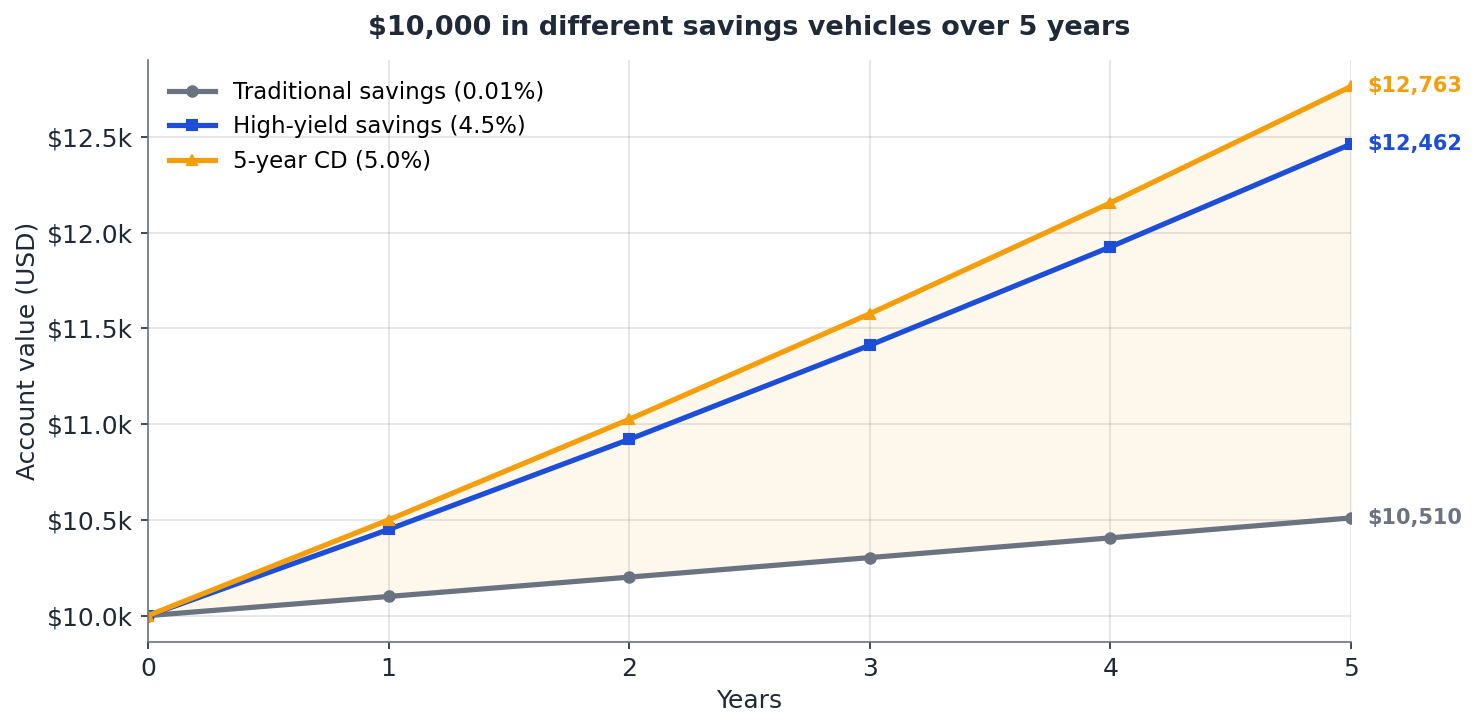
Here’s how $10,000 grows in three different vehicles:
| Vehicle | Rate | After 5 years | Interest earned |
|---|---|---|---|
| Traditional savings | 0.01% | $10,005 | $5 |
| High-yield savings | 4.5% | $12,462 | $2,462 |
| 5-year CD (compounded) | 5.0% | $12,834 | $2,834 |
The difference between traditional savings and a high-yield account is $2,457 over 5 years — for exactly the same risk. If you have more than $1,000 sitting in a Bank of America or Chase savings account earning 0.01%, you’re losing money every single month.
When to Choose a High-Yield Savings Account
A HYSA wins in these scenarios:
1. Emergency fund (3-6 months of expenses)
Emergencies don’t schedule themselves. You need to access this money immediately when you lose a job, face a medical bill, or need car repairs. A CD’s early withdrawal penalty defeats the purpose.
2. Savings for unknown timing
Saving for a house down payment “in the next 1-3 years”? A HYSA gives you flexibility to withdraw when the right opportunity arrives.
3. When rates are rising
If you expect the Federal Reserve to raise rates (as they did through 2023), a HYSA’s rate rises with them. Locking into a CD means missing out on those increases.
4. Ongoing contributions
Most HYSAs let you add money anytime. CDs typically don’t — you lock in a fixed amount at the start.
When to Choose a CD
A CD wins when:
1. You expect rates to fall
If rates are at a peak and likely to decline (as in late 2024), locking in a 5% CD for 5 years is brilliant. When the bank lowers its savings rate to 2%, your CD keeps paying 5%.
2. Known future expense
Saving for a wedding in 18 months? A 12-month CD guarantees your rate and prevents you from spending the money impulsively.
3. Retirement income stabilization
Retirees often use a “CD ladder” — splitting money across CDs of varying maturities — to create predictable income while earning more than a savings account.
4. Disciplined saving
If you’re tempted to dip into savings, a CD’s withdrawal penalty acts as a commitment device. Sometimes friction is a feature.
The Hybrid Strategy: CD Laddering
For larger cash holdings ($25k+), consider a CD ladder:
- Divide your money into 5 equal chunks
- Invest each in CDs of 1, 2, 3, 4, and 5-year terms
- As each CD matures, reinvest into a new 5-year CD
Result: One CD matures every year (liquidity), and you capture the higher long-term rates. This is a classic strategy for conservative investors.
Use our CD calculator to model different term lengths and APYs — see exactly how much interest you’d earn on any deposit amount.
Hidden Costs and Gotchas
HYSAs:
- Rate can drop anytime — the bank can lower your APY with ~30 days notice
- Withdrawal limits — federal law used to cap withdrawals at 6/month (relaxed in 2020, but some banks still enforce)
- Teaser rates — some banks offer promotional rates that drop after 3-6 months
CDs:
- Early withdrawal penalties — typically 3-6 months of interest for short CDs, 12+ months for long ones
- Inflation risk — if inflation averages 3% and your CD pays 4%, your real return is just 1%
- Reinvestment risk — when your CD matures, prevailing rates may be much lower
Where to Find the Best Rates
Never accept your existing bank’s rate without shopping around. The best rates are almost always at:
- Online banks: Ally, Marcus by Goldman Sachs, Discover, SoFi, Capital One 360
- Credit unions: Often beat big banks by 1-2 percentage points
- Brokered CDs: Available through brokerage accounts (Fidelity, Schwab) — sometimes offer better rates than direct bank CDs
A 30-minute search can easily earn you an extra 1-2% per year — hundreds or thousands of dollars over time.
The Bottom Line
For most people, the answer is both:
- HYSA for your emergency fund and short-term flexibility (60-70% of cash)
- CDs for money you definitely won’t need before maturity (30-40% of cash)
And regardless of which you choose, get your money out of a 0.01% traditional savings account today. You’re literally giving the bank an interest-free loan.
Run your numbers with our CD calculator and savings goal calculator — see exactly how much your money can grow, and start earning what your savings deserve.
Try it yourself
Numbers are better when they're your numbers. Run your own numbers with our free calculator.
Open Calculator