APR vs Interest Rate: What's the Difference?
The interest rate and APR on a loan are not the same thing. Learn the difference, see how fees inflate your true borrowing cost, and never get fooled again.
When you see a loan advertised as “5.99% interest,” you might assume that’s what you’ll pay. But there’s a second number — the APR — that reveals your true cost of borrowing. And the gap between them can be shocking.
Understanding the difference between interest rate and APR is one of the most financially valuable things you’ll ever learn. It can save you thousands on your next mortgage, car loan, or personal loan.
The Simple Definitions
Interest rate is the cost of borrowing the principal, expressed as a percentage. If you borrow $10,000 at 6% interest, you pay $600/year in interest (before amortization).
APR (Annual Percentage Rate) includes the interest rate plus certain upfront fees — origination fees, points, broker fees, and some closing costs — spread across the life of the loan. APR is designed to show your true annual cost of borrowing.
💡 The rule: APR is always equal to or higher than the interest rate. If a lender advertises a rate with fees, the APR is the number that matters.
Why This Matters: A Real Example
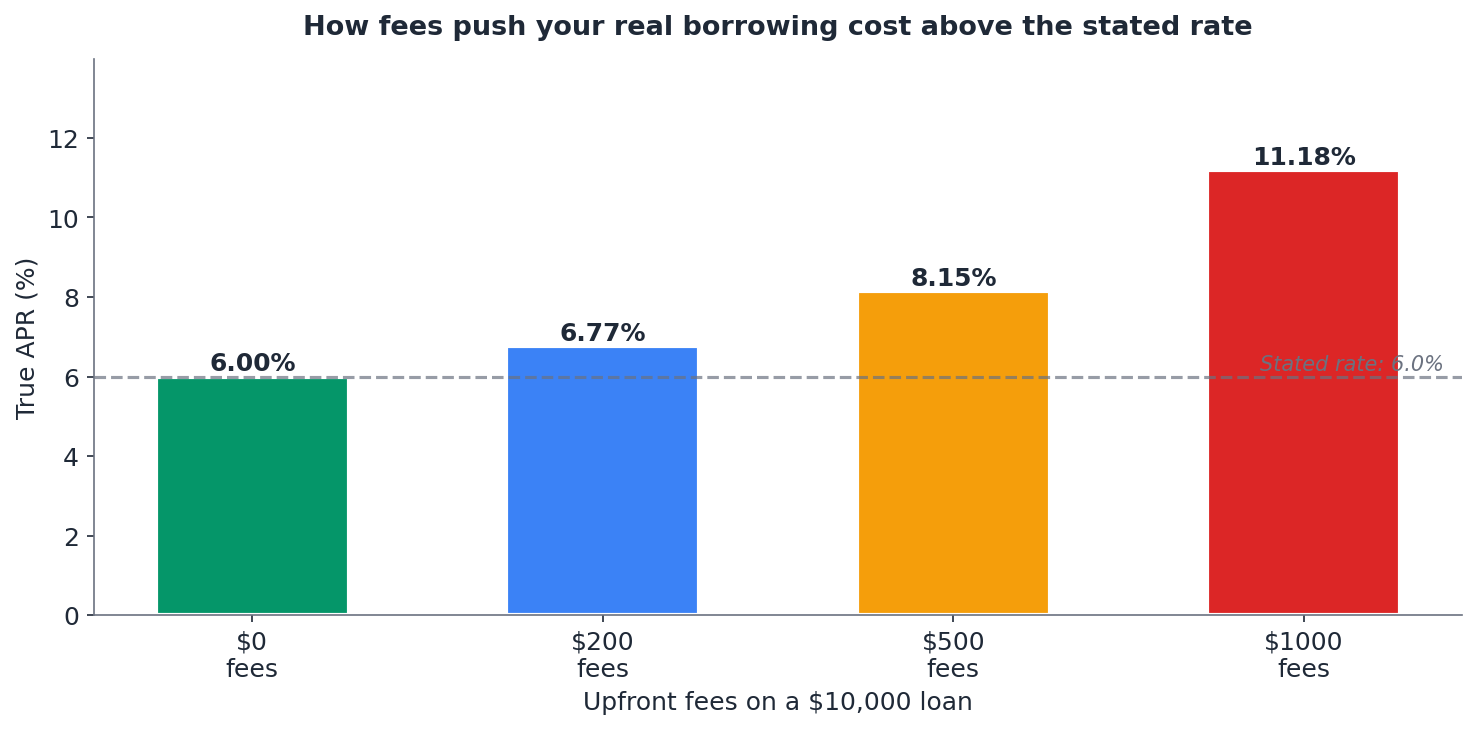
Let’s see how fees inflate your true borrowing cost on a $10,000 personal loan at a stated 6% interest rate for 5 years:
| Upfront fees | Stated rate | True APR | Difference |
|---|---|---|---|
| $0 | 6.00% | 6.00% | 0% |
| $200 | 6.00% | 6.77% | +0.77% |
| $500 | 6.00% | 8.15% | +2.15% |
| $1,000 | 6.00% | 11.18% | +5.18% |
With $1,000 in fees on a $10,000 loan, your true APR is nearly double the advertised rate. You’re paying $1,000 in fees to borrow money that effectively costs you 11.18% per year — almost as much as a credit card.
This is why always comparing APRs — not interest rates — is the single most important thing when shopping for a loan.
How APR Is Calculated
The math is conceptually simple: find the interest rate that, applied to the net loan amount (principal minus fees), produces the same monthly payment as the original loan.
If you borrow $10,000 with $500 in fees, you only receive $9,500. But you make payments on the full $10,000 at 6% interest. The APR is the rate that, applied to the $9,500 you actually got, would produce those same payments.
For a precise calculation on your own loan, use our APR calculator — enter any loan amount, fees, rate, and term to see your true borrowing cost instantly.
Which Fees Are Included in APR?
Not all fees count toward APR. Here’s the general breakdown:
Typically included:
- Origination fees (the lender’s charge for processing the loan)
- Discount points (upfront payment to lower your rate — common on mortgages)
- Mortgage broker fees
- Some closing costs (varies by loan type)
Typically NOT included:
- Appraisal fees (mortgages)
- Title insurance and search fees
- Credit report fees
- Notary and recording fees
- Property taxes and homeowners insurance (paid regardless of loan)
This means the APR might still understate your true cost if there are many excluded fees. Always ask the lender for a “Loan Estimate” (mortgages) or “Truth in Lending” disclosure that itemizes every fee.
APR Across Different Loan Types
APR matters differently depending on the loan:
Mortgages
APR is most useful here because mortgage fees (points, origination, broker) can be substantial. Always compare mortgage APRs, not just rates. A 6.5% rate with $5,000 in fees might have a 6.85% APR — that’s the number to compare.
Credit Cards
Credit card APR is the interest rate — there typically aren’t upfront fees. But watch out for annual fees, balance transfer fees, and late fees, which aren’t reflected in the APR.
Auto Loans
Auto loans often have low fees, so APR and interest rate are usually close. But dealer-originated loans sometimes include hidden “documentation fees” that push APR up.
Personal Loans
Personal loans (especially from online lenders) often charge 1-8% origination fees, creating a large gap between the interest rate and APR. This is where comparing APR matters most.
Fixed vs Variable APR
A fixed APR stays the same for the life of the loan. Most mortgages and personal loans are fixed.
A variable APR changes over time based on an index (like the prime rate). Credit cards and some private student loans are typically variable. With variable APR, your advertised rate is just the starting point — it can go up (or down).
APR vs APY: Don’t Confuse Them
One more distinction worth knowing:
- APR = what you pay on a loan. Doesn’t include compounding.
- APY (Annual Percentage Yield) = what you earn on savings. Includes compounding.
A loan with 12% APR (monthly compounding) effectively costs you 12.68% APY over a year. Banks quote loans in APR (looks lower) and savings in APY (looks higher) — both are designed to make the bank look good.
Practical Takeaways
- When comparing loans, use APR — not interest rate. It’s the only fair comparison.
- Ask for the APR in writing before signing anything. Federal law requires lenders to disclose it.
- Watch for “teaser rates” — a low introductory rate that jumps after 6-12 months.
- Negotiate fees, not just rates. Many lenders will waive or reduce origination fees if you ask.
- Consider a no-fee lender even at a slightly higher rate. The APR might end up lower.
The Bottom Line
The interest rate tells you what the bank says it’s charging. The APR tells you what you’re actually paying. Always trust the APR.
Before your next loan, run the numbers yourself with our APR calculator — enter the principal, fees, stated rate, and term to see your true cost of borrowing. Knowledge is leverage when negotiating with lenders.
Try it yourself
Numbers are better when they're your numbers. Run your own numbers with our free calculator.
Open Calculator