15-Year vs 30-Year Mortgage: Which Is Better?
Compare 15 and 30-year mortgages with real numbers. See how monthly payments, total interest, and lifetime cost differ — and which is right for you.
When you’re shopping for a mortgage, the 30-year fixed loan is the default choice for most Americans. But the 15-year mortgage deserves a serious look — it can save you hundreds of thousands of dollars in interest and let you own your home outright decades earlier.
The trade-off? A much higher monthly payment. This guide breaks down the math with real numbers, so you can decide which option fits your life.
The Quick Comparison
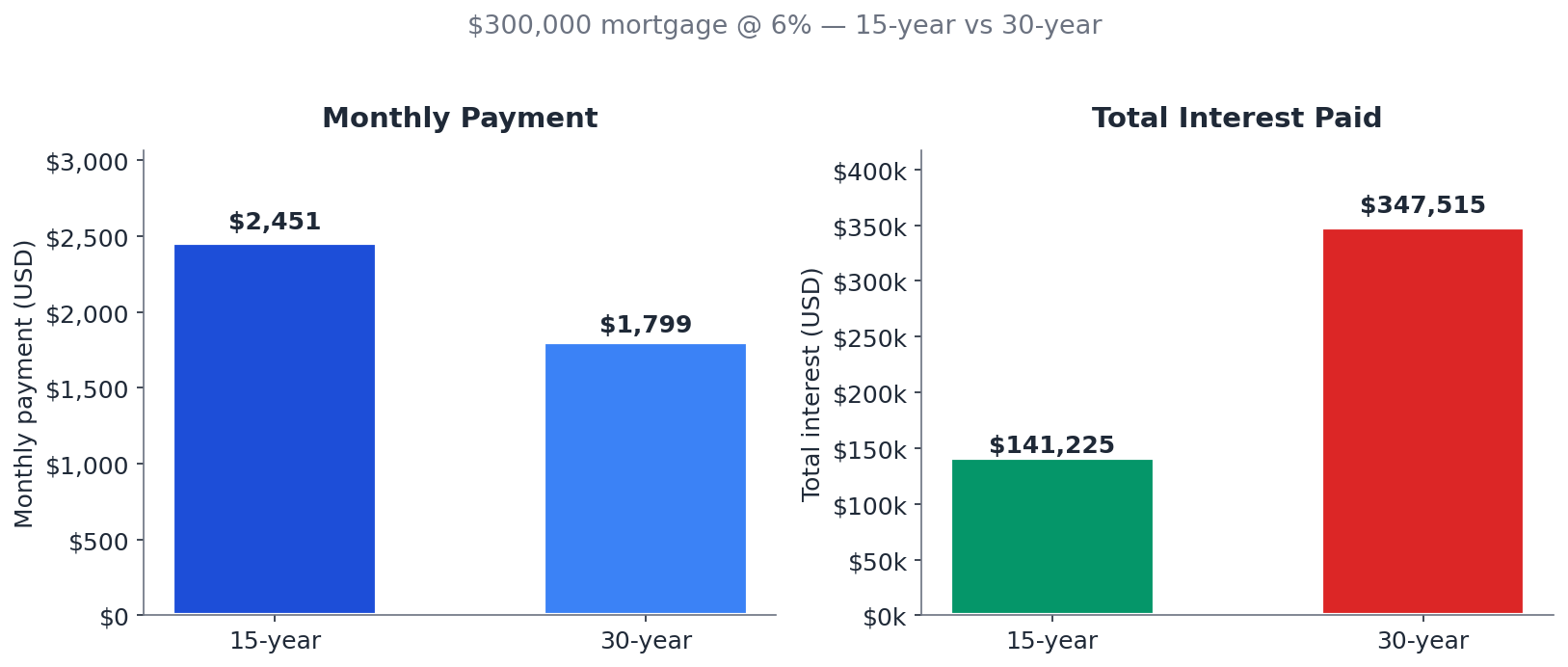
Let’s use a concrete example: a $300,000 mortgage at today’s rates. We’ll assume a 6.5% rate on the 30-year and 6.0% on the 15-year (15-year rates are typically 0.5% lower because they’re less risky for lenders).
| Metric | 15-year @ 6.0% | 30-year @ 6.5% |
|---|---|---|
| Monthly payment (P&I) | $2,532 | $1,896 |
| Total paid over loan life | $455,720 | $682,632 |
| Total interest paid | $155,720 | $382,632 |
| Years to own outright | 15 | 30 |
The 30-year costs you $226,912 more in interest over its life — nearly enough to buy another small house. That’s the price of flexibility.
Case for the 30-Year Mortgage
Lower monthly payment = breathing room
The 30-year’s $1,896 payment is $636/month cheaper than the 15-year. That cash can go toward:
- Maxing out retirement accounts (401k, IRA) — which may earn 7-10% and compound tax-free
- Building a 6-month emergency fund so a job loss doesn’t mean losing the house
- Paying off higher-interest debt like credit cards (20% APR) before tackling a 6.5% mortgage
- Investing in other assets — diversification beats putting all your net worth in one house
You can always pay extra
Here’s the secret most people miss: a 30-year mortgage can be paid off in 15 years if you want to. Just add $636/month to your payment. You get the option of the lower payment when you need it, and the speed of a 15-year when you don’t.
The reverse isn’t true — if you take a 15-year and hit hard times, you can’t magically lower the payment.
Inflation works in your favor
Your payment is fixed, but inflation erodes its real value. A $1,896 payment feels very different in 2026 than it will in 2050. With the 30-year, you’re paying back tomorrow’s mortgage with cheaper inflated dollars.
Case for the 15-Year Mortgage
Massive interest savings
The numbers don’t lie: $226,912 in interest savings on a $300k loan. That’s life-changing money — enough to fund a child’s college education, retire years earlier, or buy a vacation home.
Forced discipline
Some people say they’ll invest the difference but actually spend it on lifestyle inflation. The 15-year mortgage is a “forced savings plan” — you build equity whether you want to or not.
Builds equity faster
If you need to sell or refinance in 5-10 years, the 15-year leaves you with substantially more equity. After 10 years on a $300k loan:
- 15-year: ~$168,000 in principal paid off
- 30-year: ~$44,000 in principal paid off
That’s a $124,000 difference in your net worth.
Psychological freedom
There’s enormous peace of mind in being mortgage-free by age 45 or 50 — right when college costs and retirement planning peak. Many homeowners describe paying off their mortgage early as life’s greatest financial relief.
The Hybrid Strategy: Best of Both Worlds
If you’re torn, consider this approach recommended by many financial planners:
- Take the 30-year mortgage for the safety of low payments
- Set up automatic extra payments of $300-500/month toward principal
- This effectively turns it into a ~20-year mortgage
- If you ever hit financial trouble, pause the extra payments with zero consequences
You capture most of the interest savings while keeping the flexibility. Run the numbers yourself with our mortgage calculator — try your loan amount with both 15 and 30-year terms, then experiment with the amortization schedule.
When Each Option Wins
Choose 30-year if:
- You’re early in your career and expect income growth
- You haven’t maxed out tax-advantaged retirement accounts
- You have other debt at higher interest rates
- Your emergency fund is thin
- You want to invest the difference (and actually will)
- Your job or industry has income volatility
Choose 15-year if:
- You’re 45+ and want to be mortgage-free before retirement
- You’re financially disciplined and have a full emergency fund
- You’ve maxed out retirement accounts and want another wealth-building vehicle
- You’re risk-averse and value certainty
- You plan to stay in this home long-term
A Hidden Factor: Qualifying
Lenders use stricter debt-to-income (DTI) ratios for 15-year mortgages because the payment is higher. On a $100k income, you might qualify for a $400k home with a 30-year but only a $280k home with a 15-year.
If you’re set on a 15-year but can’t qualify, take the 30-year and pay extra — same result, easier approval.
The Bottom Line
There’s no universal right answer. The math favors the 15-year (huge interest savings), but the life favors the 30-year (flexibility, investment opportunity, lower risk).
The worst choice is a 30-year mortgage with no extra payments and no investment strategy for the difference. Pick a path and commit to it.
Run your numbers with our free mortgage calculator — switch between 15 and 30-year terms, view the amortization schedule, and see exactly how much interest you’d save. The numbers tell the truth.
Try it yourself
Numbers are better when they're your numbers. Run your own numbers with our free calculator.
Open Calculator